
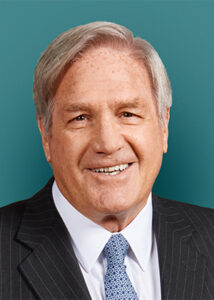
Thirty years after helping bring guardianship to the forefront of public policy, former Massachusetts Attorney General Scott Harshbarger believes one of the Commonwealth’s most important human services issues is still hiding in plain sight.
Much of that conversation began in 1995, when Scott convened the Bentley College Conference on Guardianship. This was the first statewide effort in several decades to bring advocates, legal professionals, and policymakers together to examine how Massachusetts could strengthen its guardianship system.
At the time, guardianship had emerged as part of a broader focus on elder protection. While serving as District Attorney and later Attorney General, Scott saw firsthand how older Americans were disproportionately targeted by fraud, financial exploitation, and other white-collar crimes. Many were isolated, living alone, or lacked strong support systems, making them especially vulnerable.
 Programs focused on elder protection opened the door to collaboration with other entities, including the Guardianship Task Force, which had formed in the 1980’s around a similar mission, led by the late Tony Winsor of the Disability Law Center and others, including Wynn Gerhard and John Ford. Through these collaborative efforts, Scott came to see that guardianship was not simply a legal process issue, but a critical social justice safeguard for people who have no one else to advocate for them.
Yet despite its importance, guardianship remained largely invisible.
“The need for focus on, and the impact of invisibility about guardianship never emerged as a major public issue, let alone a crisis, even after our Conference in 1995,” Scott said. “At the time, guardianship was still a low-public-policy and volunteer process. There were few people available to do this, let alone educated, trained professionals. And, absent a major tragedy, it was just one of those issues that remained firmly off the public policy or media radar screen.”
Even so, Scott remembers a feeling of momentum building. There was growing recognition that Massachusetts needed a coordinated approach to protecting vulnerable adults, and Scott believed the Commonwealth was “on the path to leading the way.”
Looking back, however, he notes that Massachusetts never took the final, critical policy and regulatory step: creating a statewide public guardianship office responsible for overseeing guardianship, and ensuring a systemic entity responsible for accountability, resources, education, training, and maybe above all, advocacy for those who, without us, have no one.
In 2015, Scott joined with Wynn Gerhard, John Ford, Peter Macy and other stakeholders to establish the Massachusetts Guardianship Policy Institute and a Steering Committee to explore legislation for a public guardian in Massachusetts. The Institute initiated a pilot project, Public Guardian Services, in Braintree, Massachusetts, in 2020, which now provides guardians for 80 vulnerable, unrepresented adults.
Notwithstanding these efforts, three decades after the Guardianship Conference in 1995, Scott believes many of the same challenges remain. One of the biggest obstacles continues to be that guardianship issues and policy rarely command sustained public attention, because they happen one person at a time rather than as a highly public crisis, and have no public policy leadership or status.
“Guardianship issues and challenges don’t happen in mass. They happen individually. They happen in isolation. They happen one at a time,” Scott said. “These issues happen at different times to different people in different ways, and almost always well below the radar and in private.”
That complexity, he says, is precisely why guardianship requires more than a more efficient and effective court appointment. It requires balancing two equally important responsibilities: protecting an individual’s right to independence while ensuring that people who cannot safely navigate life’s challenges still receive the support they need. It also requires trained professionals, informed family members, accountability, and systems working together.
For Scott, that broader system—focused on public leadership, collaboration and accountability—is still missing.
Instead of a statewide office responsible for coordinating guardianship policy, identifying systemic problems, supporting guardians, and ensuring quality services, many of those responsibilities have, by default and in spite of the need, fallen to non-profit organizations like Public Guardian Services and the Center for Guardianship Excellence.
“This major public policy and process responsibility should not be the responsibility only of heroic and dedicated small, private nonprofit entities that provide excellent services, with limited resources, recognition, and political and public policy clout,” Scott said.
Scott believes guardianship also offers one of the clearest windows into larger problems across healthcare and human services. Because organizations like PGS work with some of the Commonwealth’s most complex cases, they see the breakdowns that other institutions encounter only in pieces — from delayed hospital discharges and barriers to long-term care placement to gaps in community services. The ramifications ripple across Massachusetts.
“If you’re looking at these major health care, long-term care and community service resources costs and gaps from the guardianship perspective, you see the scope, complexity and potential remedies and solutions of and for these problems more clearly, urgently and better than anybody else,” Scott said.” The issues are not legal due process per se,” Scott said. “They are social justice issues.”
Rather than simply filling gaps, Scott believes organizations like PGS, The Center for Guardianship Excellence, and the Massachusetts Guardianship Policy Institute are demonstrating what a coordinated statewide system could look like through training, education, advocacy, and person-centered care.
The challenge, he says, is that guardianship remains fragmented across courts, hospitals, long-term care providers, community organizations, and state agencies.
“People don’t know it until it happens to them,” Scott said. “It’s very siloed.”
Nevertheless, thirty years after helping launch Massachusetts’ first statewide conversation on guardianship, Scott believes the Commonwealth has available the expertise, experience, and models needed to finish the work it began. And we have plenty more work to do.
“We have a compelling case for a statewide public policy reform,” Scott said, “but we still have failed to mobilize the political and policy advocacy clout and voice needed to agree on a Public Guardian, which is the one thing that might truly achieve the outcomes we believe are absolutely within our reach. More importantly, we need a public leader to pick up the mantle launched 30 years ago and be that champion in the arena.”
At its heart, however, Scott emphasizes that this work has never been about policy alone. It’s about ensuring that the poor, the powerless, and society’s most vulnerable are not left facing these moments alone — on the sidelines or in the dark. It’s about ensuring they have responsible, skilled, and effective advocates standing on their behalf when they need them most, supported by a statewide entity committed to building and sustaining a system that delivers, as best we humanly can, fair and equal justice alongside compassionate, skilled, person-centered care.